
Rev Interactive’s Approach to Weatherproof LED Screens for Outdoor Use
Rev Interactive designs weatherproof LED screens using IP-rated, corrosion-resistant enclosures and gasketed, service-access seals to guarantee moisture and dust ingress LED screen display. Thermal strategies employ conduction paths, fins, heat pipes and phase-change materials to manage ambient and transient loads. Optics and LED binning guarantee sunlight legibility with adaptive dimming tied to sensors and predictive models. Rugged electronics use conformal coating, redundancy, and modular hot-swap units for uptime. Integrated telemetry and secure remote management support predictive maintenance and lifecycle optimization; more technical details follow.
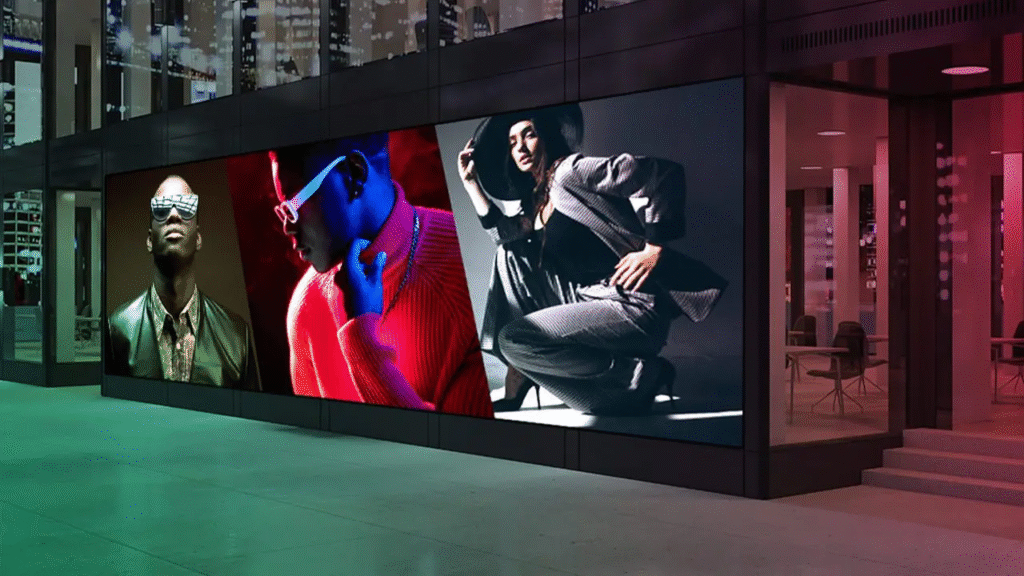
Outdoor-Rated Hardware and Enclosures
When deploying LED screens outdoors, hardware and enclosures must be specified to withstand environmental stressors—IP-rated cabinets, corrosion-resistant frames, and sealed connectors provide the primary defense against water ingress, dust, and salt air. The team selects marine grade enclosures for coastal installations, prioritizing materials and finishes that resist galvanic corrosion and salt crystallization. Mounting systems are engineered for wind load and thermal expansion, enabling installation crews autonomy in placement. Vandal resistant casings are specified where public access is expected, balancing impact tolerance with serviceability through tamper-secure fasteners and access panels. Electrical compartments are segregated, with drainage channels and positive-pressure ventilation where necessary. Procurement focuses on tested components with traceable ratings, reducing field modification and preserving operational freedom under varied climates.
Advanced Sealing and IP Protection
The section addresses the role of IP rating standards in specifying enclosure performance against dust and water ingress, emphasizing measurable criteria (e.g., IP65–IP68) for outdoor LED installations. It then compares gasket designs and potting compounds as primary sealing strategies, outlining trade-offs in serviceability, vibration resistance, and moisture migration. Finally, guidance is provided on selecting sealing methods to meet target IP levels while maintaining thermal management and ease of maintenance.
IP Rating Standards
How effectively can an LED display withstand particulate ingress and water exposure in real-world outdoor installations? The IP rating framework provides a concise, standardized ingress classification that quantifies protection against solids and liquids. Manufacturers rely on environmental testing to validate sealing strategies and to inform deployment decisions across climates. Strategic selection of IP levels balances durability, serviceability, and freedom of placement.
- IP65: dust-tight and protection against low-pressure water jets; suitable for exposed façades and semi-sheltered mounts.
- IP66/IP67: higher water ingress resistance; appropriate for open plazas and intermittent immersion risk.
- IP68: continuous immersion tolerance; reserved for permanently submerged or extreme-wet environments.
Rev Interactive uses IP standards as objective acceptance criteria for outdoor display specification and procurement.
Gasket and Potting Methods
In sealing outdoor LED displays for reliable IP performance, gasket and potting methods address different intrusion pathways by combining mechanical compression seals with encapsulant barriers to block dust, water, and capillary migration. The approach segregates functions: gaskets provide removable service access and controlled compression, while potting compounds eliminate microchannels around sensitive electronics. Material selection targets gasket longevity through UV, ozone, and compression set resistance; cross-linked silicone and fluorosilicone are favored where flexibility and rebound matter. Potting compounds are specified for thermal conductivity, cure profile, and low shrinkage to avoid stress on solder joints. Design tolerances define seal compression, drainage paths, and secondary barriers. Together these methods create a tolerant, maintainable system that prioritizes freedom of deployment and predictable IP performance.

Thermal Management and Passive Cooling
Because outdoor LED modules operate in wide temperature ranges, effective thermal management and passive cooling strategies are essential to maintain luminance stability and component longevity. Rev Interactive emphasizes a layered approach: enclosure conduction paths, optimized fin geometry, and materials that buffer thermal spikes. Passive elements reduce failure modes without adding energy constraints, supporting installations that prioritize autonomy and freedom from active maintenance. Designers integrate heat pipes and phase change materials selectively to redistribute and absorb transient loads while preserving uniform junction temperatures. Key implementation points include:
- Robust chassis conduction: machined interfaces and thermal pads to move heat to external surfaces.
- Surface topology: fin density and placement tuned for prevailing airflow.
- Material selection: corrosion-resistant alloys and PCMs sized to expected duty cycles and ambient profiles.
Sunlight Readability and Brightness Control
Sunlight readability for weatherproof LED screens hinges on achieving high-nit brightness levels that overcome direct solar irradiance without compromising panel longevity. Complementary adaptive dimming algorithms modulate output in real time to preserve contrast, reduce power draw, and prevent thermal stress. Together these strategies balance peak luminance requirements with energy efficiency and component reliability.
High-Nit Brightness Levels
How bright must an outdoor LED display be to remain legible in direct daylight? Rev Interactive specifies high-nit thresholds calibrated to site conditions, balancing extreme luminance with practical energy tradeoffs. Designers select peak nits for direct-sun exposure, tempering output to prevent washout while preserving contrast and color fidelity.
- Peak brightness ratings aligned to ambient lux levels for maintainable legibility.
- Hardware choices (phosphor, LED binning, optics) prioritized for sustained output and thermal resilience.
- Power-budgeting guidelines and cooling strategies to manage duty cycles and operational lifespan.
The approach emphasizes measurable targets, site-specific specification, and modular scaling so operators retain freedom to choose brightness versus runtime. Metrics and test protocols validate compliance without relying on adaptive dimming discussions.
Adaptive Dimming Algorithms
Typically, adaptive dimming algorithms modulate LED module output in real time by integrating ambient light sensors, scheduled site profiles, and feedback from onboard photometric measurements to maintain perceived contrast and color fidelity while minimizing power draw and thermal stress. The system employs sensor fusion to correlate wide dynamic range luminance data with temperature and seasonal profiles, enabling deterministic responses to transient events such as glare or cloud cover. Predictive dimming models forecast short-term illumination trends using historical site telemetry and weather feeds, allowing preemptive brightness adjustments that preserve readability without abrupt shifts. Algorithms prioritize local contrast retention and uniformity across panels, while enforcing thermal limits and energy budgets. Configuration exposes strategic parameters for operators who require autonomy over visibility, power, and lifecycle trade-offs.
Ruggedized Electronics and Redundancy
Several layers of ruggedization and redundancy are essential to guarantee continuous operation of outdoor LED screens under harsh environmental and operational conditions. Rev Interactive specifies fault tolerant architectures and modular redundancy to isolate failures, enabling individual module replacement without system downtime. Enclosures, conformal-coated PCBs, and temperature-compensated power supplies form the hardened baseline. Strategic component selection secures operational freedom across climates and use cases.
- Physical ruggedization: sealed housings, vibration dampers, and corrosion-resistant materials.
- Electronic redundancy: dual power rails, mirrored control units, and error-correcting interconnects.
- Design for service: hot-swappable modules, standardized connectors, and clear failure indicators.
The approach prioritizes predictable behavior, graceful degradation, and straightforward field maintenance procedures without dependence on continuous external intervention.
Maintenance, Monitoring, and Remote Management
Building on ruggedized architectures, effective maintenance, monitoring, and remote management establish the operational feedback loop that preserves uptime and optimizes lifecycle costs for outdoor LED screens. Rev Interactive implements automated telemetry and cloud diagnostics to collect real-time metrics—temperature, humidity ingress, power draw, pixel health—and routes them to a centralized dashboard. Predictive maintenance algorithms analyze trends, flagging components nearing failure and scheduling targeted interventions to avoid unplanned outages. Remote management capabilities include secure firmware updates, configuration rollback, and granular access controls, enabling teams to act from anywhere while maintaining sovereignty over systems. The strategy minimizes on-site labor, reduces spare-part inventories, and extends service intervals. Documentation and API-driven controls guarantee operators retain freedom to integrate bespoke workflows and audit trails.
Frequently Asked Questions
How Do These Screens Handle Saltwater Corrosion Near Coastal Installations?
They mitigate saltwater corrosion by applying marine grade coatings and integrating sacrificial anodes, creating redundant protection layers; corrosion monitoring informs proactive maintenance schedules, enabling resilient coastal deployments while preserving operator autonomy and strategic control.
Are There Options for Customizable Screen Shapes or Curved Installations?
Yes; the company offers custom shaped modules and supports flexible curvature, enabling curved and irregular installations. The technical strategy balances modularity, structural reinforcement, and serviceability to maximize design freedom while maintaining environmental and performance specifications.
What Power Backup Options Exist for Prolonged Grid Outages?
Battery banks and fuel generators provide primary prolonged outage options: modular lithium battery banks enable silent, scalable runtime; diesel or biodiesel fuel generators deliver high-capacity, continuous power. Strategic hybrid systems combine both for redundancy and user-controlled independence.
Can the Screens Integrate With Third-Party Content Management Systems?
Yes. The screens support API integration and cloud compatibility, enabling secure RESTful connections, tokenized authentication, and scalable content sync. This strategic, technical design grants operators freedom to orchestrate third-party CMS workflows and system autonomy.
What Warranties and Service-Level Agreements Are Offered for Outdoor Use?
Standard warranties cover hardware defects for warranty duration of three to five years; service-level agreements specify response times for critical failures (typically 2–4 hours), on-site repair windows, and escalation procedures ensuring operational freedom.
Conclusion
Rev Interactive’s weatherproof LED solutions combine purpose-built outdoor-rated enclosures, precision sealing to achieve high IP protection, and passive thermal designs to guarantee reliable operation under varied climates. High-brightness, adaptive control and ruggedized electronics with redundant pathways maximize visibility and uptime. Integrated monitoring and remote management enable proactive maintenance and rapid response. Collectively, these engineered measures deliver a resilient, serviceable platform that meets stringent environmental, operational, and lifecycle performance requirements for outdoor deployments.